
Oticon Intent vs Oticon Real & More: Should You Upgrade in Pakistan?
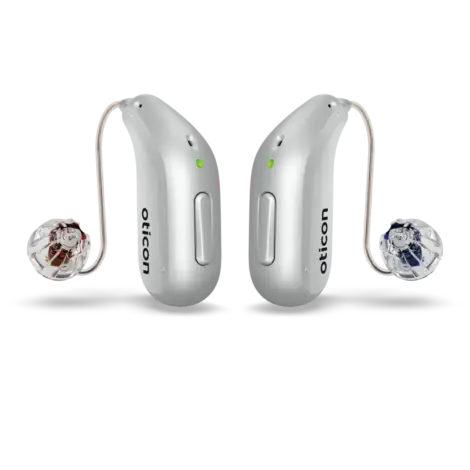
- Oticon Intent introduces the Sirius™ processor and the world’s first 4D User-Intent sensors.
- DNN 2.0 provides 35% more speech access in background noise compared to Oticon More and Real.
- Native Bluetooth LE Audio and Auracast ensure seamless compatibility with modern mobile ecosystems and public audio.
RIC Oticon Intent Rechargeable
Danish manufacturer Oticon (part of Demant) has built a global reputation around its unique BrainHearing™ philosophy. Rather than narrowly clamping down on background noise like traditional hearing aids, Oticon designs processors that support how the human brain naturally processes sound—giving wearers access to the full 360-degree acoustic scene so they can choose what to focus on.
Over the past five years, Oticon has driven rapid architectural leaps: from the breakthrough Oticon More (the world's first hearing aid with an onboard Deep Neural Network), to Oticon Real (introducing sudden-sound and wind stabilizers), to their flagship platform: Oticon Intent.
At Ensound Hearing Centre in DHA Phase 1, Lahore, many existing Oticon wearers ask us: "I am currently using Oticon More or Oticon Real. Is upgrading to Oticon Intent worth it for my daily life in Pakistan?"
This clinical comparison breaks down the exact technological shifts between these three generations, explains how 4D User-Intent sensors change the listening experience, and helps you decide whether an upgrade is clinically indicated.
1. Technological Evolution: More vs. Real vs. Intent
| Feature / Metric | Oticon More (2021) | Oticon Real (2023) | Oticon Intent (2024–2026 Flagship) |
|---|---|---|---|
| Processing Platform | Polaris™ Chip | Polaris R™ Chip | Sirius™ Next-Gen Chip |
| Artificial Intelligence | Deep Neural Network 1.0 (12M scenes) | Deep Neural Network 1.0 with RealSound | Deep Neural Network 2.0 (Trained on complex real-world audio) |
| User-Intent Sensing | Acoustic analysis only | Acoustic analysis only | 4D Sensors (Head movement, body motion, acoustic dynamics) |
| Speech Clarity in Noise | Good 360° awareness | Improved handling of soft speech | 35% More speech access in high noise |
| Sudden Noise Suppression | Standard transient management | SuddenSound Stabilizer | Enhanced SuddenSound + Wind/Handling Stabilizer |
| Bluetooth Standard | Bluetooth Classic / ASHA | Bluetooth Classic / ASHA | Bluetooth LE Audio & Native Auracast™ Ready |
| Rechargeable Battery | Standard Li-Ion (3h full charge) | Standard Li-Ion (3h full charge) | Micro-Lithium Fast Charge (30 min = 8h, 2h = 24h) |
| Hardware Form Factor | miniRITE R | miniRITE R | Smallest rechargeable miniRITE Oticon has ever built |
2. The Breakthrough: What Are 4D User-Intent Sensors?
Previous hearing aids—including Oticon More and Real—made amplification decisions based solely on the acoustic environment around you. If you were in a loud restaurant on MM Alam Road, the aid reacted to the room's noise levels, regardless of what you were trying to do.
Oticon Intent is the first hearing aid in history that monitors what the wearer intends to do:
- Acoustic Sensors: Evaluates the 360-degree sound scene 500 times per second to measure noise intensity, speech presence, and frequency dynamics.
- Head Movement Sensors: Detects when you turn your head toward a specific person speaking, prompting the aid to instantly prioritize that conversation.
- Body Motion Sensors: Senses whether you are seated in quiet discussion or actively walking through a crowded market, widening the sound field so you maintain awareness of approaching traffic or people.
- Conversation Dynamics Sensors: Distinguishes whether you are participating in a lively multi-person conversation or merely listening to ambient background music.
By combining all four sensor dimensions, Oticon Intent provides up to 5 dB of additional acoustic support precisely when your brain needs it to follow complex conversations in noise.
3. Deep Neural Network 2.0 (DNN 2.0)
Both Oticon More and Oticon Real utilized the first-generation Deep Neural Network (DNN 1.0). While revolutionary at the time, DNN 2.0 inside Oticon Intent was trained on a vastly larger, more complex corpus of sound recordings.
DNN 2.0 processes speech with greater clarity across high frequencies, preserving the delicate acoustic consonants (s, f, th) that are so crucial for understanding spoken Urdu and English. In clinical audiological trials, Intent wearers demonstrated 35% better access to speech cues and reported 10% less listening fatigue compared to previous generations.
4. Connectivity: Bluetooth LE Audio & Auracast™
If you stream phone calls, audio messages, or television, the wireless jump in Oticon Intent is substantial:
- Oticon More and Real relied on older Bluetooth MFi (Apple) and ASHA (Android) protocols, which can experience drops on certain Android handsets and draw heavier battery current.
- Oticon Intent is engineered from the ground up with Bluetooth Low Energy (LE) Audio and native Auracast™ broadcast compatibility. It delivers high-fidelity stereo audio with near-zero latency, lower battery drain, and direct compatibility with emerging public broadcast systems in airports, mosques, and auditoriums across Pakistan.
5. Faster, Smaller Rechargeability
For daily convenience, Oticon Intent introduced a redesigned contactless inductive charging system:
- Smaller Size: The Intent miniRITE casing is visibly slimmer and more discreet behind the ear than either More or Real.
- Rapid Charging: While More and Real required 3 full hours for a complete charge, Oticon Intent achieves a full 24-hour runtime in just 2 hours.
- Quick Boost: A rapid 30-minute charge delivers 8 full hours of power—ideal if you forgot to charge overnight before a busy morning meeting in Lahore.
The Clinical Verdict: Should You Upgrade?
- If you are wearing Oticon More (or older Opn / Opn S models):
Yes, an upgrade is strongly recommended. The leap in speech clarity, the introduction of 4D sensors, the smaller physical casing, and native Auracast connectivity represent a transformative day-to-day improvement in listening effort and noise performance.
- If you are wearing Oticon Real:
An upgrade is beneficial if you spend significant time in demanding social or professional settings (weddings, boardrooms, crowded restaurants) where Real reaches its limits, or if you want future-proof Auracast and rapid charging. If your daily life is mostly spent in quiet home settings, your Oticon Real remains an exceptional digital instrument.
Experience Oticon Intent at Ensound Hearing Centre
At Ensound Hearing Centre in DHA Phase 1, Lahore, our clinicians carry official Oticon diagnostic programming hardware (Genie 2). We offer live in-clinic comparative trials, allowing you to compare your current hearing aids against Oticon Intent before making any decision.
Every hearing aid fitted at Ensound includes:
- A 1-year manufacturer warranty
- Custom ear molds
- 6 months of complimentary batteries (for non-rechargeable models)
- A first fine-tuning follow-up consultation at 4 weeks
- 1 full year of free clinical programming and adjustments
Key Takeaways
- Oticon Intent introduces the next-generation Sirius™ processor and the world’s first 4D User-Intent sensors.
- Deep Neural Network 2.0 provides 35% more speech access in noisy environments compared to older generations.
- Native Auracast & LE Audio ensure compatibility with future public broadcast systems in Pakistan.
- Fast-charge micro-lithium battery delivers 24 hours of wear on a 2-hour charge.
Book a Hearing Aid Consultation in Lahore
Schedule a demonstration of Oticon Intent with our clinical team at Ensound Hearing Centre:
- Location: 12-G Second Floor, Phase 1 DHA, Lahore, 54000
- Telephone / WhatsApp: +92 300 4219127
- Consultation Booking: Schedule an Oticon Evaluation
Related Hearing Care Guides
Need Personalized Advice on Hearing Aids?
Book a diagnostic consultation with our audiologists at 12-G Second Floor, Phase 1 DHA, Lahore.