
Oticon vs Signia Hearing Aids: A Clinical Comparison for Pakistan Patients
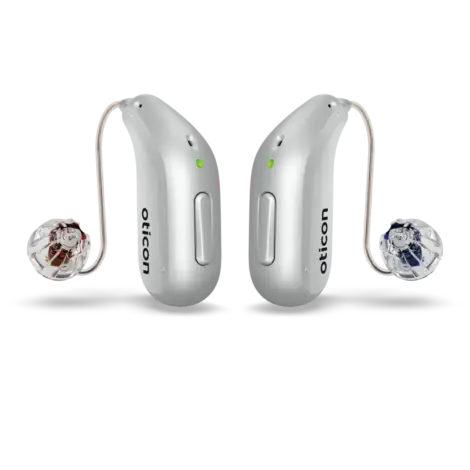
- Oticon's OpenSound philosophy gives the brain access to the full sound scene; Signia's Augmented Focus separates speech from background with a dual-processor chip.
- Signia's Own Voice Processing (OVP™) makes it particularly comfortable for first-time wearers bothered by the occlusion effect.
- The right choice depends on your audiogram, daily listening environments, and smartphone ecosystem — not brand loyalty.
RIC Oticon Intent Rechargeable
When patients visit us at Ensound Hearing Centre asking which hearing aid brand is "better" — Oticon or Signia — our answer is always the same: it depends on your audiogram, your lifestyle, and how you want to experience sound. Both are clinically respected manufacturers with decades of research behind them. Both offer modern rechargeable devices, Bluetooth connectivity, and sophisticated noise management.
But their underlying sound processing philosophies are meaningfully different, and those differences can matter in practice.
This article provides a balanced, factual comparison of the two brands to help you have a more informed conversation with your audiologist.
A Brief Background on Each Brand
Oticon is a Danish hearing aid manufacturer founded in 1904, making it one of the oldest in the industry. It is now part of the Demant Group. Oticon has invested significantly in neuroscience research, and its current technology is built around what the company calls BrainHearing — a philosophy that argues the brain, not just the ears, should drive the design of hearing technology.
Signia is a German hearing aid brand, a business unit of WS Audiology (which also owns Widex). It has its roots in the legacy Siemens hearing aid division, which has over a century of manufacturing history. Signia's identity centres on technical innovation and a strong emphasis on sound naturalness, particularly the wearer's experience of their own voice.
Core Sound Processing Philosophy
Oticon: Open Sound Experience and BrainHearing
Oticon's flagship technology platform — currently Oticon Intent (launched 2024) — is built on the principle that the brain processes sound most effectively when it receives a full, balanced soundscape rather than heavily directionally filtered audio.
Traditional hearing aids typically suppress sounds from the sides and behind, directing the microphone beam forward to isolate the speaker. Oticon's approach — sometimes called Open Sound — argues that this aggressive filtering deprives the brain of the contextual information it uses to make sense of the auditory environment. Their devices use a Deep Neural Network (DNN) trained on millions of real sound scenes to distinguish speech from noise, and then preserve more of the surrounding acoustic environment while still enhancing speech.
The practical implication: Oticon users often report a more natural, open listening experience. Some find it easier to follow conversations in complex social situations because the sound field feels less artificially constrained.
Signia: Augmented Focus and Own Voice Processing
Signia's current platform — Signia Integrated Xperience (IX) — uses a fundamentally different approach called Augmented Focus. This is a dual-processor architecture: one processing stream is dedicated to the primary speech signal (the person you are talking to), while a second stream handles background sound. The two streams are recombined at the output stage.
The result is a more clearly delineated foreground/background experience — many users describe speech sounding distinctly "in front" of ambient noise, which can be a significant benefit in highly complex listening environments.
A notable Signia innovation is Own Voice Processing (OVP). Many first-time hearing aid wearers are bothered by how their own voice sounds through the devices — commonly described as hollow, booming, or "echoey." Signia's OVP uses a dedicated processor to detect the wearer's own voice and process it separately from environmental sound, creating a more natural self-perception. This is an area where Signia has historically differentiated itself clinically.
Rechargeable Options
Both brands offer lithium-ion rechargeable options across their main product ranges.
- Oticon rechargeable devices (e.g., Oticon Intent, Oticon Real) use a proprietary charging case and offer approximately 24 hours of use per charge, including several hours of streaming.
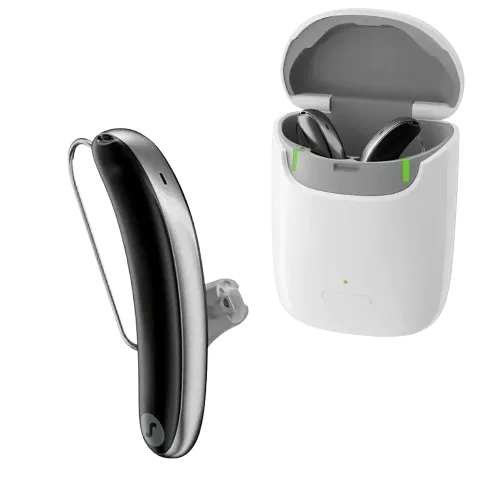
- Signia rechargeable devices (e.g., Signia Pure Charge&Go IX) follow a similar profile, with a portable charging case available as an option.
For older adults or those with reduced finger dexterity, rechargeable devices remove the need to handle small hearing aid batteries — a meaningful practical consideration.
Bluetooth and Connectivity
Both brands have modern Bluetooth ecosystems:
- Oticon uses Bluetooth LE Audio (in current Intent models) for direct connection to both iPhone and Android devices, as well as TV streamers and remote microphones.
- Signia uses standard Bluetooth connectivity supporting direct iOS streaming and Android streaming via their app, with a range of accessories including TV streamers and the StreamLine Mic for remote microphone use.
The choice of smartphone platform matters here. If a patient has strong brand loyalty to either Apple or Android, this is worth discussing with the audiologist during the fitting.
Who Each Brand Tends to Suit
This is not a prescription — individual audiograms and trial fittings are the only reliable guide — but clinically, certain profiles tend to emerge:
| Characteristic | May Favour Oticon | May Favour Signia |
|---|---|---|
| Social lifestyle (groups, gatherings) | ✓ Open sound may feel more natural | |
| Strong preference for clear speech separation | ✓ Augmented Focus architecture | |
| Bothered by how own voice sounds | ✓ OVP processing | |
| Mild to moderate high-frequency loss | ✓ | ✓ |
| Severe to profound loss | ✓ (Oticon Xceed BTE) | ✓ (Signia BTE range) |
| Strong preference for Android | ✓ (LE Audio) | ✓ |
Again, these are generalisations. A fitting trial — wearing both devices under real-world conditions — is the most reliable method for selecting the right device for an individual patient.
The Role of Fitting Quality
Whichever brand is chosen, the quality of the audiological fitting matters more than the device brand. A premium device programmed inaccurately to the audiogram will underperform a mid-range device fitted with precision.
At Ensound Hearing Centre, every fitting involves:
- Pre-fitting diagnostic assessment (PTA, Tympanometry, speech testing)
- Audiogram-based programming
- A first review appointment at four weeks to assess real-world performance and refine settings
- One year of free programming adjustments
- Six months of batteries included
- Custom ear moulds where indicated
- One-year manufacturer warranty
Both Oticon and Signia are brands we can advise on in the context of a full hearing assessment and fitting at our DHA Phase 1, Lahore clinic.
Key Takeaways
- Oticon's BrainHearing / Open Sound philosophy aims to preserve the full auditory scene, letting the brain do more of the work — often described as natural and open.
- Signia's Augmented Focus creates a clear distinction between primary speech and background — often described as giving speech a clear "foreground" quality.
- Signia's Own Voice Processing (OVP) directly addresses the common complaint of unnatural self-voice perception in new hearing aid wearers.
- Both brands offer competitive rechargeable options and Bluetooth connectivity for iPhone and Android.
- No brand is universally superior — the right choice depends on the individual audiogram, lifestyle, and a trial fitting.
Ready for a Professional Assessment?
The best way to choose between Oticon, Signia, or any other brand is to have a comprehensive hearing assessment and then trial devices under real-world conditions. Our clinical team at Ensound Hearing Centre (DHA Phase 1, Lahore) can help you make a genuinely informed choice — not just a brand-driven one.
Book your hearing assessment →
Related articles:
Related Hearing Care Guides
Need Personalized Advice on Hearing Aids?
Book a diagnostic consultation with our audiologists at 12-G Second Floor, Phase 1 DHA, Lahore.