Pure Tone Audiometry (PTA) in Lahore: How to Read Your Audiogram & What It Means
- Pure Tone Audiometry (PTA) measures the softest sounds heard across speech frequencies (125 to 8,000 Hz).
- Air conduction vs bone conduction testing differentiates conductive from sensorineural hearing loss.
- The "speech banana" explains why high-frequency consonant sounds (s, f, th) disappear before loud vowels.
When you suspect hearing loss or visit an audiology clinic for a hearing evaluation, the cornerstone test you will undergo is Pure Tone Audiometry (PTA). Often referred to simply as an "audiometry test" or "hearing test," PTA is the international gold standard for measuring your auditory sensitivity across the range of human speech frequencies.
At Ensound Hearing Centre in DHA Phase 1, Lahore, we conduct Pure Tone Audiometry inside a calibrated, sound-treated acoustic suite using clinical-grade audiometers. But for many patients, the resulting graph—filled with red circles, blue crosses, brackets, and decibel numbers—can look confusing.
This clinician-written guide explains how Pure Tone Audiometry is performed, how to read your audiogram, and how our audiologists use these results to determine whether your hearing loss is conductive, sensorineural, or mixed.
What Is Pure Tone Audiometry (PTA)?
Pure Tone Audiometry is a behavioural hearing test that determines the softest sound you can hear at least 50% of the time across different pitches (frequencies).
Sound travels in waves and is characterized by two fundamental properties:
- Frequency (Pitch), measured in Hertz (Hz): Ranging from low bass rumble (125 Hz, 250 Hz) to mid-frequency vowel sounds (500 Hz, 1,000 Hz) to high-pitch consonant sounds (2,000 Hz, 4,000 Hz, 8,000 Hz).
- Intensity (Loudness), measured in Decibels (dB HL): The higher the decibel level required for you to hear a sound, the more significant your hearing loss.
How the Test Is Conducted at Ensound Hearing Centre
During a PTA session at our DHA Phase 1 clinic:
- You are seated inside our sound-isolated testing room to eliminate ambient traffic noise from Lahore.
- Air Conduction Testing: You wear calibrated supra-aural headphones or insert earphones. Pure tones are presented to one ear at a time. Whenever you hear a tone—no matter how faint—you press a response button or raise your hand. This tests the entire auditory pathway (outer ear, eardrum, middle ear bones, and inner ear cochlea).
- Bone Conduction Testing: A small vibrating oscillator is positioned on your mastoid bone behind the ear. This bypasses the outer and middle ear, directly stimulating the cochlea to measure inner ear and nerve function.
- Masking (When Indicated): If one ear hears significantly better than the other, our audiologist introduces a gentle rushing static noise into the better ear. This ensures the better ear does not "cross-hear" tones intended for the tested ear.
How to Read Your Audiogram: The X and Y Axes
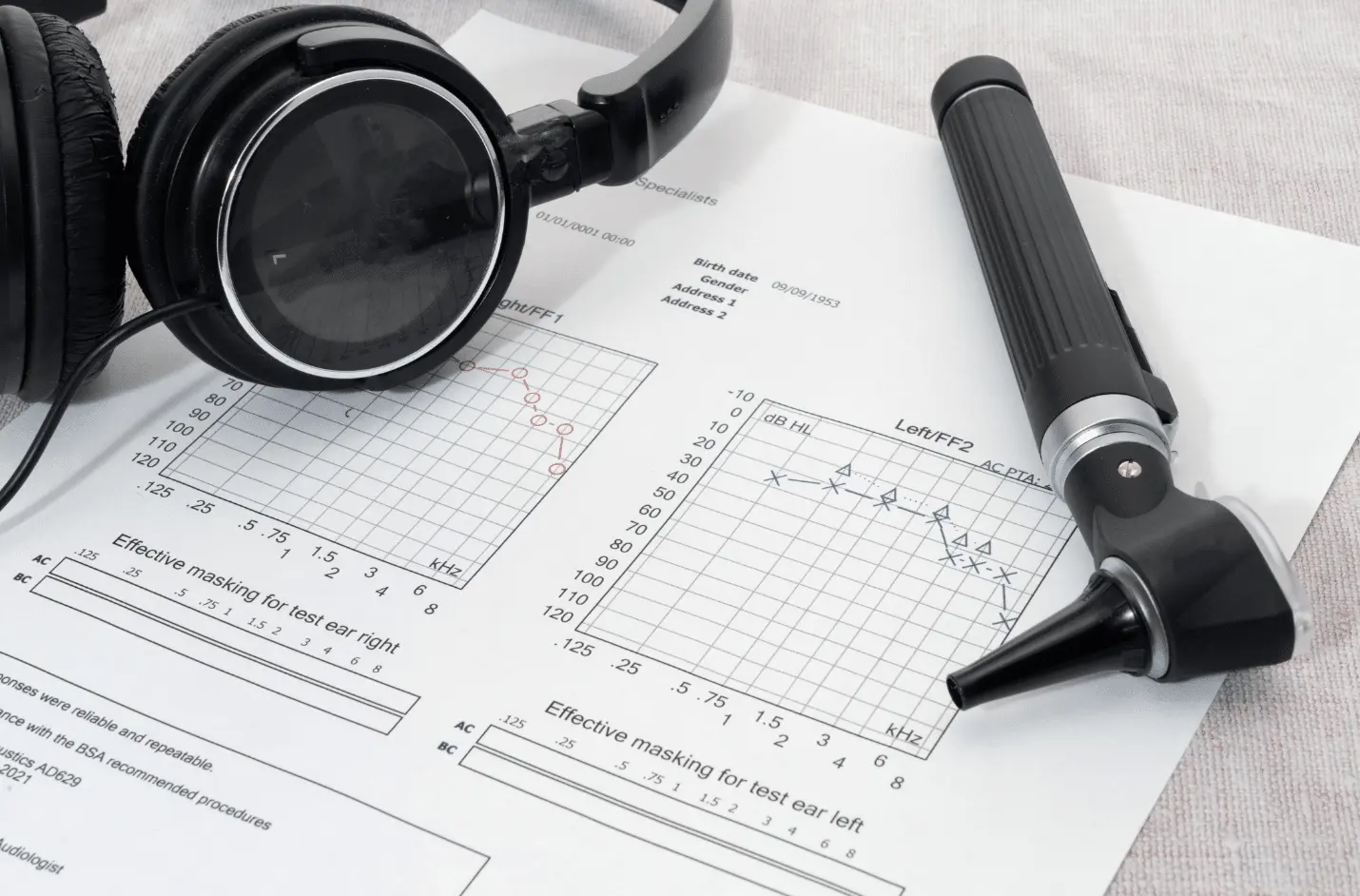
An audiogram is simply a grid:
- The Horizontal Axis (Top): Frequency / Pitch (Hz)
Runs from left to right, like piano keys. Low pitches (bass tones like traffic or distant thunder) are on the left (250 Hz), while high pitches (chirping birds, women's and children's voices, and consonant sounds like s, f, th, and sh) are on the right (4,000 to 8,000 Hz).
- The Vertical Axis (Left): Intensity / Hearing Level (dB HL)
Runs from top to bottom. Zero decibels (0 dB) is at the top (normal baseline hearing). As you move downward, decibel numbers increase (+20, +40, +70, +90 dB), representing increasingly louder sounds needed for audibility.
Standard Audiogram Symbols:
- Red Circle (O): Right Ear (Air Conduction)
- Blue Cross (X): Left Ear (Air Conduction)
- Bracket or < : Bone Conduction
Classifying Hearing Loss Degrees (WHO Standard)
By averaging your thresholds across speech frequencies (typically 500, 1000, 2000, and 4000 Hz), audiologists classify your hearing level according to World Health Organization (WHO) criteria:
| Threshold Range (dB HL) | Hearing Classification | Practical Everyday Impact |
|---|---|---|
| 0 to 20 dB | Normal Hearing | Can hear soft whispering, rustling leaves, and soft speech clearly. |
| 21 to 35 dB | Mild Hearing Loss | Difficulty hearing faint speech or following conversations in noisy rooms. |
| 36 to 50 dB | Moderate Hearing Loss | Struggles to hear normal conversation; television volume must be turned up. |
| 51 to 70 dB | Moderately-Severe Loss | Conversational speech is unclear; group conversations are very difficult. |
| 71 to 90 dB | Severe Hearing Loss | Normal speech is inaudible; wearers rely heavily on lip-reading and high-power amplification. |
| 91+ dB | Profound Hearing Loss | Very loud sounds only perceived; requires super-power hearing aids or cochlear implants. |
The "Speech Banana" and Why Consonants Disappear First
On an audiogram, the range where normal human conversational speech occurs resembles the shape of a banana between 20 and 50 dB HL across 250 to 5,000 Hz.
In age-related hearing loss (presbycusis) and noise-induced loss, thresholds typically slope downward towards the high frequencies (2,000 to 6,000 Hz). Vowels (a, e, o, u) carry acoustic volume and sit in low frequencies, while consonants (s, t, f, k, sh) carry clarity and sit in high frequencies.
This explains the classic phrase we hear from patients in Lahore: "I can hear people talking, but I cannot understand what they are saying!" You hear the loud vowel volume, but miss the high-frequency consonants that distinguish words like cat, hat, and sat.
Identifying the Type of Hearing Loss
Comparing air conduction (headphones) against bone conduction (mastoid oscillator) reveals the physiological location of the problem:
- Sensorineural Hearing Loss (SNHL): Both air and bone conduction thresholds are equally depressed (no "air-bone gap"). This indicates damage to cochlear hair cells or the auditory nerve (commonly caused by aging, noise exposure, or genetics).
- Conductive Hearing Loss: Bone conduction is completely normal, but air conduction is impaired (creating an "air-bone gap"). This points to an obstruction or mechanical issue in the outer or middle ear (such as earwax impaction, fluid behind the eardrum, or eardrum perforation).
- Mixed Hearing Loss: Both inner ear damage and middle ear mechanical problems exist simultaneously.
The Ensound Precision Fitting Guarantee
A Pure Tone Audiogram is not just a diagnostic snapshot; it serves as the exact blueprint used to program digital hearing aids. Modern devices from Oticon, Widex, Signia, ReSound, and Phonak feature multiple frequency channels that our audiologists fine-tune to match the contours of your personal audiogram curve.
Every consultation and hearing aid fitting at Ensound Hearing Centre includes:
- A 1-year manufacturer warranty
- Custom-molded ear impressions
- 6 months of complimentary batteries for disposable models
- A first fine-tuning follow-up consultation at 4 weeks
- 1 full year of free clinical programming and adjustments
Schedule Your Diagnostic PTA Test in Lahore
If you or a loved one are experiencing missed words, elevated TV volume, or muffled conversations, visit Ensound Hearing Centre for a comprehensive evaluation:
- Location: 12-G Second Floor, Phase 1 DHA, Lahore, 54000
- Telephone / WhatsApp: +92 300 4219127
- Appointment Booking: [Schedule a Pure Tone Audiometry Test
Related Hearing Care Guides
Need Personalized Advice on Hearing Aids?
Book a diagnostic consultation with our audiologists at 12-G Second Floor, Phase 1 DHA, Lahore.