Single-Sided Deafness (SSD): What It Is, Challenges, and How CROS vs BiCROS Hearing Aids Work
- Addresses the "head shadow effect," which causes a 6-12 dB loss of critical consonant clarity.
- CROS transmits sound from the unaidable ear to a normal hearing ear without unwanted amplification.
- BiCROS routes sound across the head while concurrently providing amplification to a loss in the better ear.
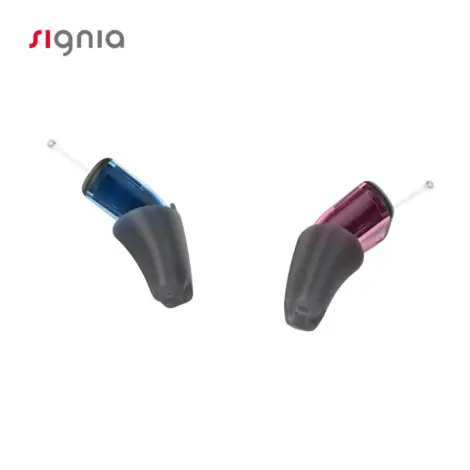
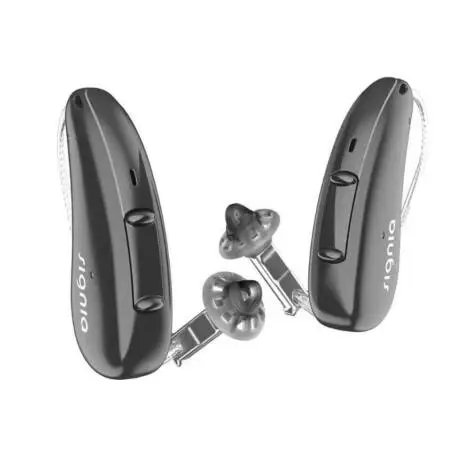
Signia Silk Charge & Go IX
Imagine sitting at a dinner table or in a conference room, and every person sitting to your right sounds crystal clear—while anyone speaking from your left is completely lost in a wall of silence. For individuals living with Single-Sided Deafness (SSD), also known as unilateral hearing loss, this exhausting scenario is a daily reality.
At Ensound Hearing Centre in Lahore, we frequently consult patients who lost hearing in one ear due to Sudden Sensorineural Hearing Loss (SSNHL), acoustic neuroma, viral infection, or physical trauma. Many were mistakenly told: "You still have one good ear, so you just have to live with it."
In modern audiology, this is completely false. Specialized CROS and BiCROS hearing systems are designed specifically to route sound from your non-hearing side over to your functional ear, restoring your 360-degree awareness.
1. The Hidden Challenges of Single-Sided Deafness
Having one healthy ear is not enough to maintain natural hearing. The human auditory system relies on two ears (binaural hearing) for two vital functions:
- The Head Shadow Effect: High-frequency sound waves cannot bend around the human skull. When someone speaks on your deaf side, your head physically blocks the sound, reducing speech clarity by 6 to 12 decibels. Consonants like "s," "f," and "th" are lost, making speech sound muffled.
- Sound Localization Failure: Our brain calculates microscopic time differences (inter-aural time difference) to tell whether a horn, siren, or voice is coming from the left or right. With one ear, sound localization is virtually impossible, which creates real safety risks in Pakistani traffic.
- Extreme Cognitive Fatigue: Because your brain is constantly straining to fill in the missing half of the conversation, individuals with SSD experience severe end-of-day exhaustion and headaches.
2. CROS vs BiCROS: What Is the Difference?
CROS stands for Contralateral Routing of Signals. Both CROS and BiCROS systems look like a pair of hearing aids, but their internal operation depends entirely on the health of your "better" ear:
| System | Deaf / Unaidable Ear | Better / Functional Ear | How It Functions |
|---|---|---|---|
| CROS | Severe to Profound (Unaidable) | Normal or Near-Normal Hearing | The transmitter on the deaf ear captures sound and wirelessly beams it to the good ear. The good ear hears the sound clearly without extra amplification. |
| BiCROS | Severe to Profound (Unaidable) | Mild to Moderate Hearing Loss | The transmitter captures sound from the deaf side and beams it over. The receiver unit also acts as a full hearing aid, amplifying both sides for the better ear's loss. |
3. How the Wireless Transmission Works
Modern CROS systems utilize high-frequency near-field magnetic induction (NFMI) or proprietary 2.4 GHz binaural audio streaming to beam audio across the head with zero noticeable delay. The transmitter microphone sits discretely on your poorer ear, while the receiving unit rests on your better ear with an open acoustic dome that preserves natural hearing.
4. Diagnostic Assessment at Ensound Hearing Centre
Determining whether CROS or BiCROS is appropriate requires comprehensive diagnostic audiometry. At our DHA Phase 1 clinic in Lahore, we conduct Pure Tone Audiometry (air and bone conduction), Speech Discrimination Testing in noise, and simulated cross-routing trials so you can experience the restoration of sound from your non-hearing side firsthand.
If you or a loved one struggles with single-sided hearing loss, schedule a comprehensive evaluation via our Contact & Consultation Page or read our in-depth guide on Signia Silk CROS: Invisible CIC Options for SSD.
Related Hearing Care Guides
Need Personalized Advice on Hearing Aids?
Book a diagnostic consultation with our certified audiologists at Building 82, Main Commercial, Sector CCA, DHA Phase 1, Lahore.